




Preserving Places, Shaping Futures: Elevating Historic Preservation Through Research and Practice
-
Category
Studio-Community, Innovation -
Posted By
Schmidt Associates -
Posted On
Sep 17, 2025
Sometimes, the best way to shape the future is to look back.
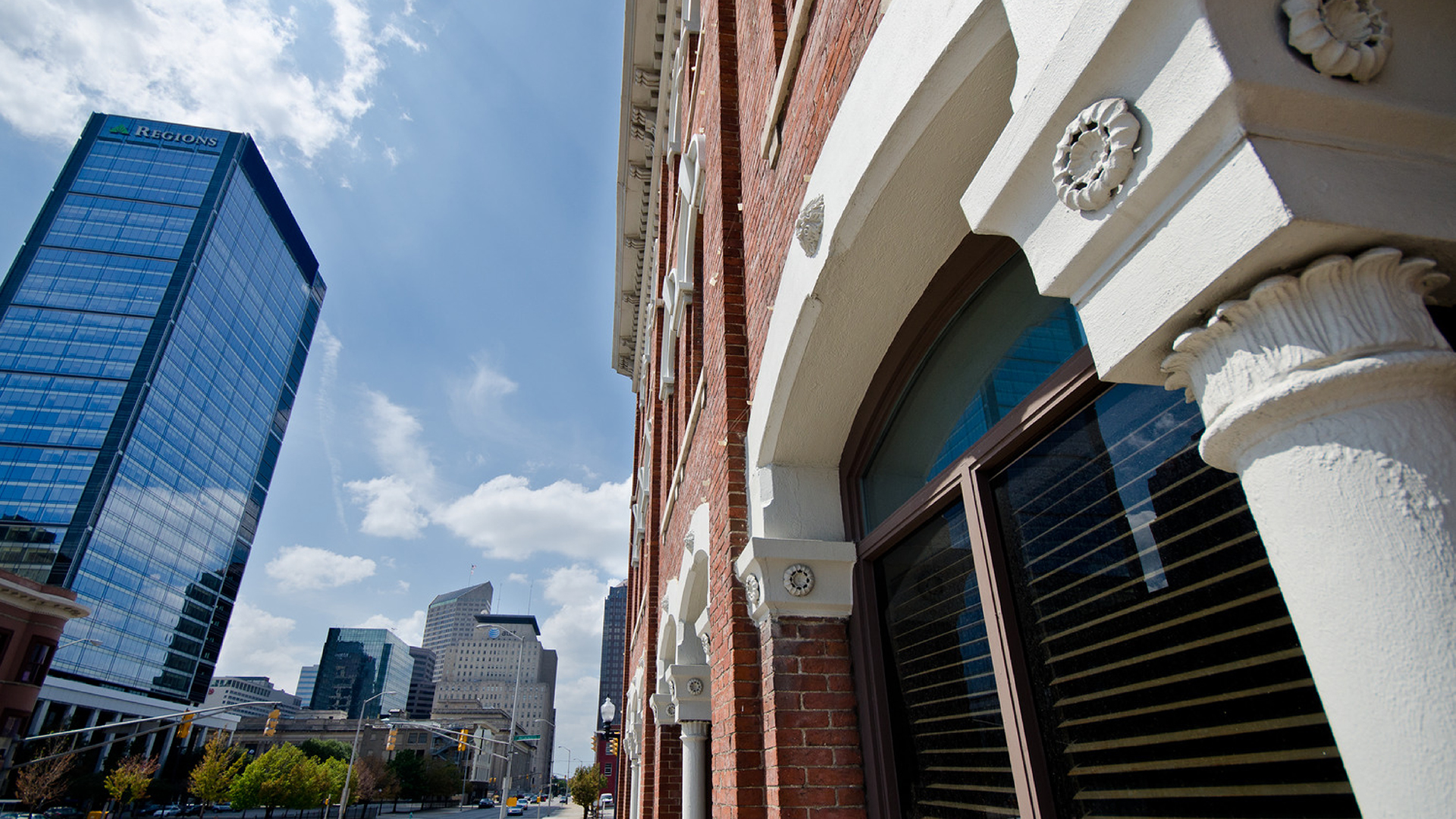
Preservation is more than a design challenge—it’s a strategic commitment to honoring identity, strengthening communities, and designing sustainably. At Schmidt Associates, preservation has been a cornerstone of our practice for decades. We restore landmarks, repurpose historic buildings, and support vibrant neighborhoods through adaptive reuse. Our work builds on that legacy while expanding how we lead in preservation today.
Preservation as Strategy and Service
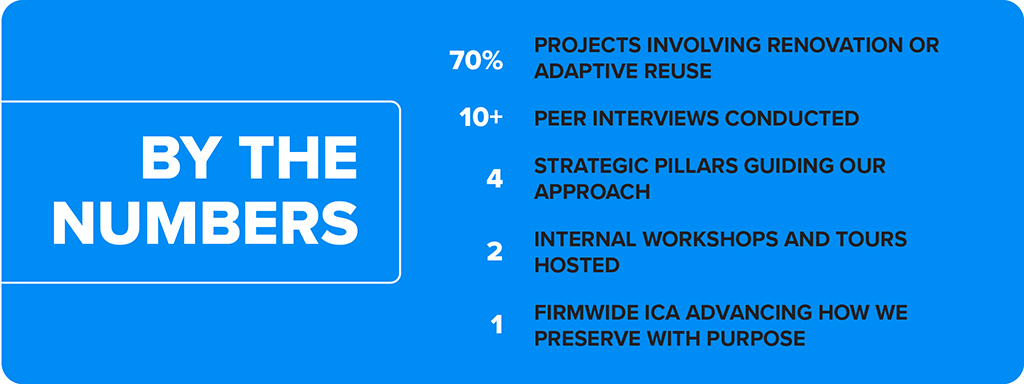
Through a firm-sponsored ICA (Industry Competitive Analysis), our “Preservation Posse”—Joseph Jarzen, Trisha Martin, and Megan Stone—conducted a yearlong, SAI grant-funded research initiative to deepen our expertise. The team studied national trends, interviewed peers, analyzed completed work, and hosted both internal and external workshops.
The research reaffirmed that preservation is not a niche. It’s a forward-looking strategy that strengthens impact across sectors:
- Sustainability — Reducing embodied carbon and conserving materials
- Community development — Reinforcing identity, economic growth, and sense of place
- Technology — Applying tools like laser scanning and historic building information modeling (HBIM)
And it’s personal. On a walking tour of Mass Ave, the team retraced the firm’s early role in downtown revitalization—from the Hammond Block to the Davlan Building, the Athenaeum, St. Joseph’s Brewery & Public House, and our own offices. These aren’t just projects; they’re enduring places where legacy and vision continue to intersect.
Preservation in Practice
Our research strengthens how we advise clients and lead design. Lessons from past work continue to shape future-focused pathways for funding, better integration of HBIM, and stronger alignment with sustainability goals.
Educational Reuse and Learning Environments
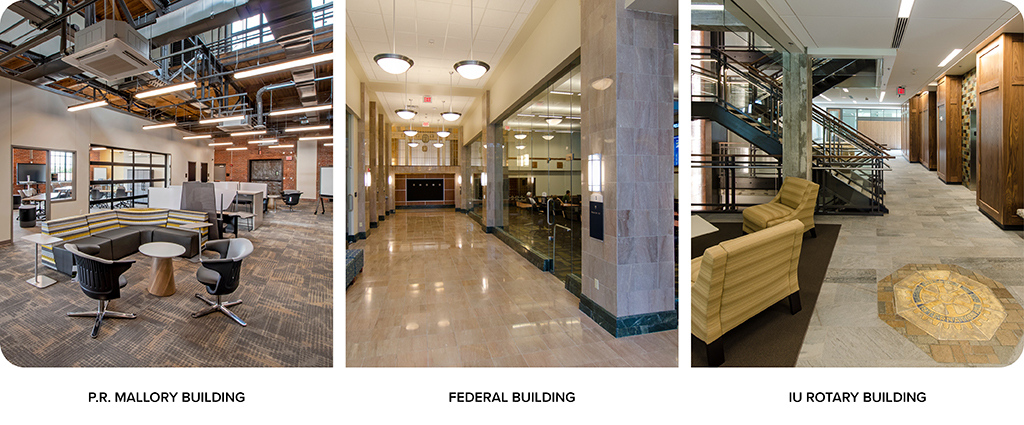
- P.R. Mallory Building, Indianapolis — A former battery factory converted into a STEM-focused high school. This transformation shows how adaptive reuse can turn underutilized industrial sites into vibrant learning environments, supporting education and workforce development goals.
- Federal Building, Terre Haute — A 1930s Art Deco structure adapted for Indiana State University’s Scott College of Business. This project blends historic character with modern academic needs, showing how institutions can preserve heritage while creating flexible, technology-rich, and sustainable spaces.
- IU Rotary Building, Indiana University — A 1931 building adapted into efficient academic and office space. The project preserved historic features, reopened a second-floor terrace, and introduced high-performance systems—earning LEED Silver while maintaining strong campus identity.
Cultural and Community Anchors
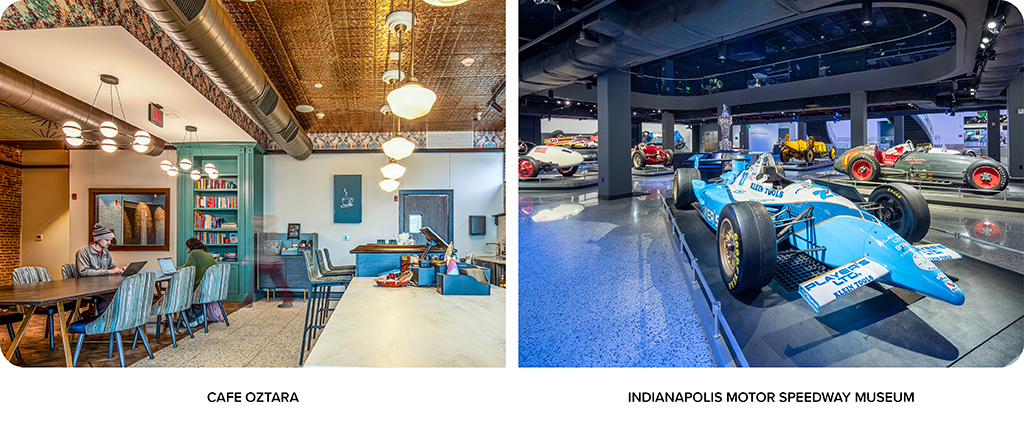
- Café Oztara, Indianapolis — A historic building reimagined as a coffee shop, art gallery, and LGBTQ+ support space. This adaptive reuse highlights how small-scale preservation can anchor communities by honoring cultural identity while driving local economic vitality.
- Indianapolis Motor Speedway Museum — A landmark institution reimagined to match the legacy it honors. This transformation enhances circulation, exhibit flexibility, and visitor engagement—creating an immersive experience that blends technology with timeless reverence for Indy’s racing heritage.
Urban Revitalization and Main Street Impact
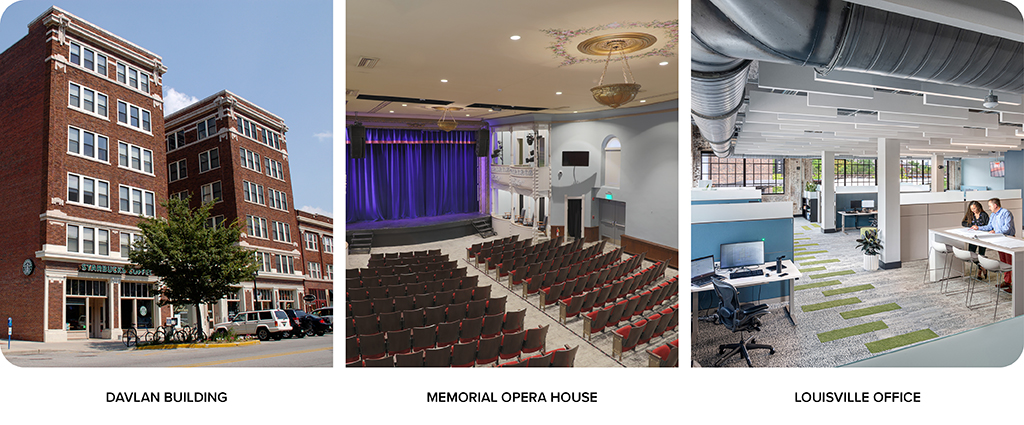
- Davlan Building, Mass Ave — Adaptive reuse that helped catalyze the district’s comeback. This project shows how a single preservation effort can spark momentum for broader urban revitalization, generating both economic and cultural ripple effects.
- Memorial Opera House — A sensitive renovation of a cherished venue that enhances guest experience while honoring legacy. The project upgraded lighting, windows, seating, and mechanical systems, added fresh restrooms, and expanded the lobby for a brighter, more welcoming entry. It balances modern functionality with architectural integrity to ensure this community space continues to thrive.
- The Louisville Office, Paristown — Our move into a restored candy factory building anchors our Kentucky presence. Choosing preservation for our own office demonstrates the long-term business and community value of adaptive reuse—showing that historic spaces can also be efficient, inspiring workplaces.
Master Planning
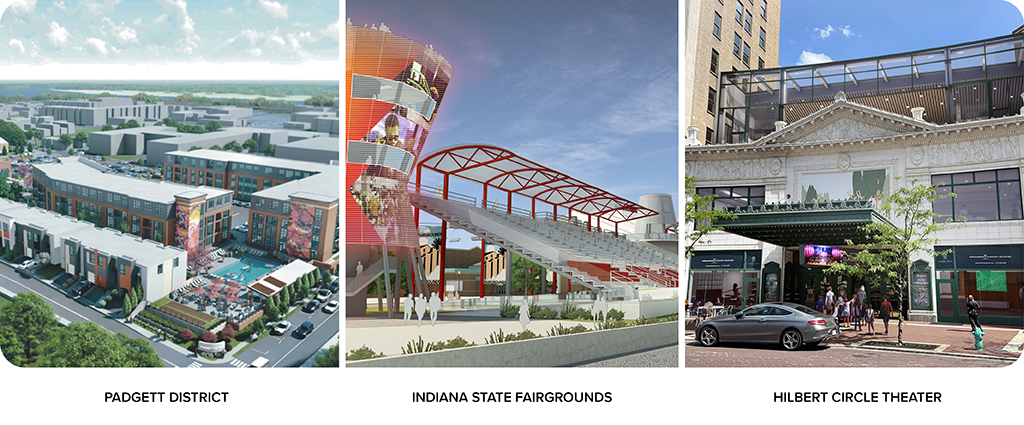
- Padgett District, New Albany — A multi-phase master plan transforming underused land into a vibrant, mixed-use neighborhood. Featuring housing, outdoor amenities, and connections to surrounding development, the plan supports community growth through thoughtful density and livability.
- Indiana State Fairgrounds — A million-square-foot assessment and master plan aimed at modernizing and revitalizing key facilities and landscapes. This plan lifts up efficiency, sustainability, and user experience through phased improvements tied to strategic priorities and stakeholder input.
- Hilbert Circle Theatre — A comprehensive assessment and master plan that charts a sustainable path forward for the symphony. Upgrades include better accessibility, enhanced building systems, and revitalized public spaces. Designed to strengthen community connection and preserve this treasured institution for future generations.
How We Approach Preservation
Preservation is never one-size-fits-all. At Schmidt Associates, we apply a flexible, context-driven approach rooted in our decades of experience and deep respect for place. Every project starts with listening—understanding the building, its community, and its potential. From there, we select the right combination of strategies to preserve purpose while planning for the future:
- Adaptive reuse — Giving buildings new purpose while retaining their character
- Restoration — Returning a space to its original appearance using historic methods and materials
- Selective intervention — Updating only what’s necessary to protect long-term integrity
- Preservation by maintenance — Extending building life through proactive, planned care
- Designing for reversibility — Ensuring modern upgrades can be undone without damage
- Compatible additions — Expanding with respect for historic scale, massing, and context
This flexible toolkit allows us to meet funding requirements, sustainability goals, and community needs—while preserving the stories and spirit that make each place unique.
What the Research Revealed
The ICA highlighted both opportunities and challenges shaping preservation today:
- Technology is underused. Tools like HBIM, thermal scanning, and digital archiving offer immense value but aren’t yet standard practice.
- Stories aren’t being told. Many firms do preservation work, but few position it as a strategic strength.
- The workforce gap is growing. Skilled preservation professionals and tradespeople are aging out. Mentorship is essential to fill the pipeline.
- Regulatory balance is nuanced. Navigating the Secretary of the Interior’s Standards while meeting modern needs for sustainability—and balancing local guidelines—requires early and clear communication.
That’s why we’re building tools to help clients assess opportunities faster and with greater confidence. We’re also investing in training, mentorship, and partnerships to ensure preservation remains strong for decades to come.
Looking Ahead
Our ICA research initiative continues to inform our preservation approach—reinforcing decades of expertise and sharpening how we deliver impact today and tomorrow. From restoring the Hammond Block in the 1970s to transforming the Federal Building into a modern academic space, preservation has always been part of who we are.
Looking forward, we’re advancing this legacy by:
- Investing in future talent through mentorship, hands-on training, and partnerships with trade schools and preservation programs to grow the next generation of skilled professionals.
- Enhancing technical capabilities with tools like HBIM, 3D scanning, and energy modeling to improve precision, sustainability, and client confidence from day one.
- Leveraging funding expertise to help clients unlock tax credits, grants, and layered financing strategies that make complex preservation projects feasible.
- Aligning preservation with sustainability goals by tracking embodied carbon savings, optimizing energy performance, and demonstrating how reuse supports climate strategies.
- Building strategic partnerships with communities, contractors, educators, and preservation advocates to deepen our reach and expand what’s possible.
- Telling the story of impact by showcasing not just beautiful transformations but also the economic, cultural, and environmental outcomes that preservation delivers.
- Supporting lifecycle stewardship with long-term services like maintenance planning, training for building operators, and ongoing building health checks to protect investment and legacy.
Preservation is not a side service—it’s central to how we deliver lasting value through thoughtful, purpose-driven design.
If you’re exploring how to bring new life to a historic structure, our team can help you navigate funding strategies, adaptive reuse, and community impact.
Learn more about Schmidt Associates’ historic preservation work here.
Share this post on