





Built to Belong: Schmidt Associates and the NCAA Headquarters
-
Category
Anniversary, Perspectives -
Posted By
Schmidt Associates -
Posted On
Jun 08, 2026
As Schmidt Associates approaches its 50th anniversary, the firm is looking back at the projects that shaped not just a portfolio, but a city. The story of the NCAA Headquarters and Hall of Champions is one of them.
In May 2026, Sports Business Journal ranked Indianapolis the No. 3 Best Sports Business City in the country, a distinction built on decades of deliberate investment that traces back further than most people realize. For Schmidt Associates, Indianapolis’s rise was not something to read about. It was something the firm helped build.
THE RIGHT CITY, THE RIGHT FIRM
When the NCAA began outgrowing its longtime home in Kansas City in the early 1990s, Indianapolis did not just make a financial pitch. It made a values pitch. Schmidt Associates had spent nearly two decades invested in the city’s growth and was ready to help make that case.

By the time the NCAA came calling, the city had spent a decade proving itself: welcoming the Colts in 1984, hosting the Pan American Games in 1987, drawing six Olympic diving trials between 1924 and 2000, and building a collection of world-class athletic venues and sports governing bodies that few cities could match.
The NCAA was not simply looking for a building. It was looking for a community that understood its mission and shared its values. Indianapolis made that case convincingly, won the bid, and turned to Schmidt Associates to build it.
THE CULTURE BEHIND THE WORK
Few inside the firm had any idea Schmidt Associates was in the running when the opportunity first surfaced.
Wayne Schmidt called the entire office together, handed everyone a small foam basketball, and told the room: Schmidt Associates had been selected to design the new NCAA Headquarters and Hall of Champions. That was Wayne’s way, rallying the whole team around a win the moment it was real because he believed everyone had a stake in the work and deserved to share in it.
It was the same philosophy he brought to every client relationship. Kevin Shelley, now chief operations officer and principal at Schmidt Associates, served as project manager on the NCAA project and watched that approach up close for years.

THREE BUILDINGS, ONE MISSION
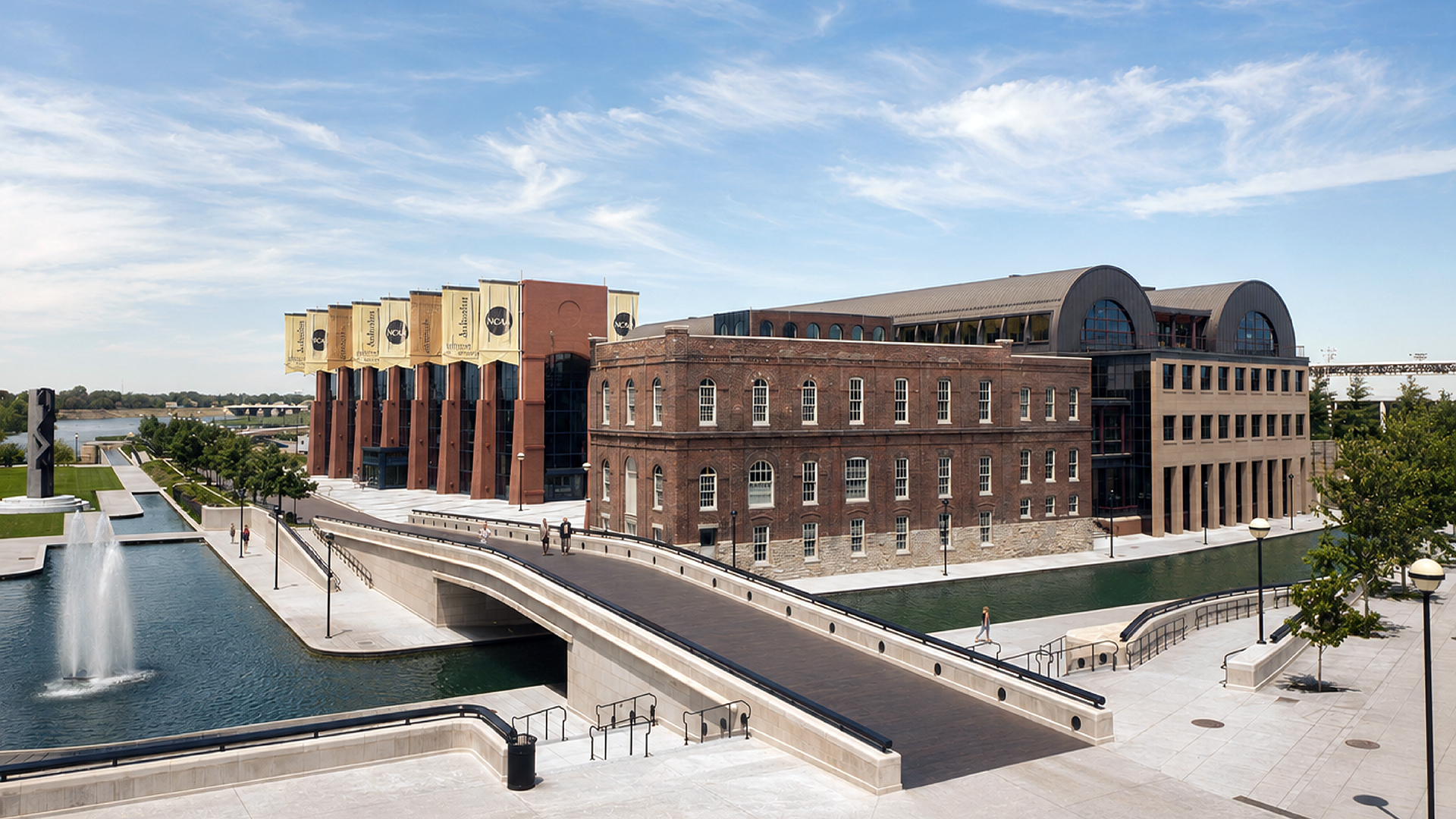
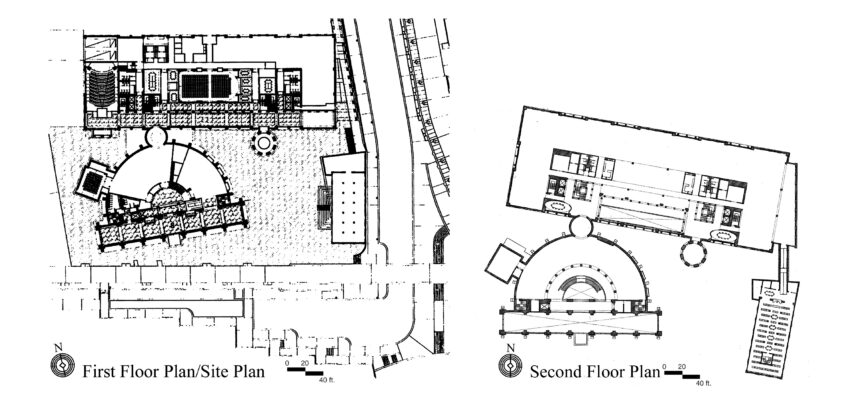
Working in association with celebrated Princeton-based architect Michael Graves, Schmidt Associates led full-service delivery on a project that demanded both national design vision and deep local knowledge. The completed complex is 180,000 square feet and occupies a permanent site along the Central Canal in White River State Park in the heart of downtown Indianapolis. Three interconnected buildings are arranged around a courtyard connecting to the park’s greensward and the promenade along the adjacent canal:
- The Office and Conference Center, a four-story block with a full-height atrium and barrel-vaulted copper roofline.
- The Hall of Champions Museum, a linked two-story hemicycle housing the exhibition center, entered through an arcade reminiscent of collegiate athletic facilities.
- A Renovated Historic Structure, the former Acme-Evans Superintendent’s Building, retained on-site to house the National Federation of State High School Associations.
DETAILS THAT TELL THE STORY
Every material choice reflected the Owner’s identity. Varying colors of brick echo the campus character of the NCAA’s member institutions, complementing the original historic building and unifying the composition. The copper roofline weathers to a patina that mirrors the dome of the nearby Indiana Statehouse, connecting the complex to Indianapolis’s civic fabric without announcing itself. The building feels like it was always supposed to be there because it was designed that way on purpose.
BUILT TO BE USED, NOT JUST ADMIRED
The Hall of Champions rises four stories, its vaulted double-barrel ceiling visible through seven massive windows along the building’s length. Inside, visitors find:
- A lobby gallery and gift shop open to the public.
- Two floors of exhibitions celebrating the history and achievements of collegiate athletics, including photographic displays of figures like Bob Knight and Larry Bird.
- A 90-seat orientation theater anchoring the museum experience.
The conference center sits at ground level adjacent to the Hall of Champions, allowing the building to serve large events without disrupting daily operations. Designing for how an Owner actually uses a building, rather than how it photographs, is what separates a project that looks good from one that works. It is also what Schmidt Associates has done on every project since 1976.
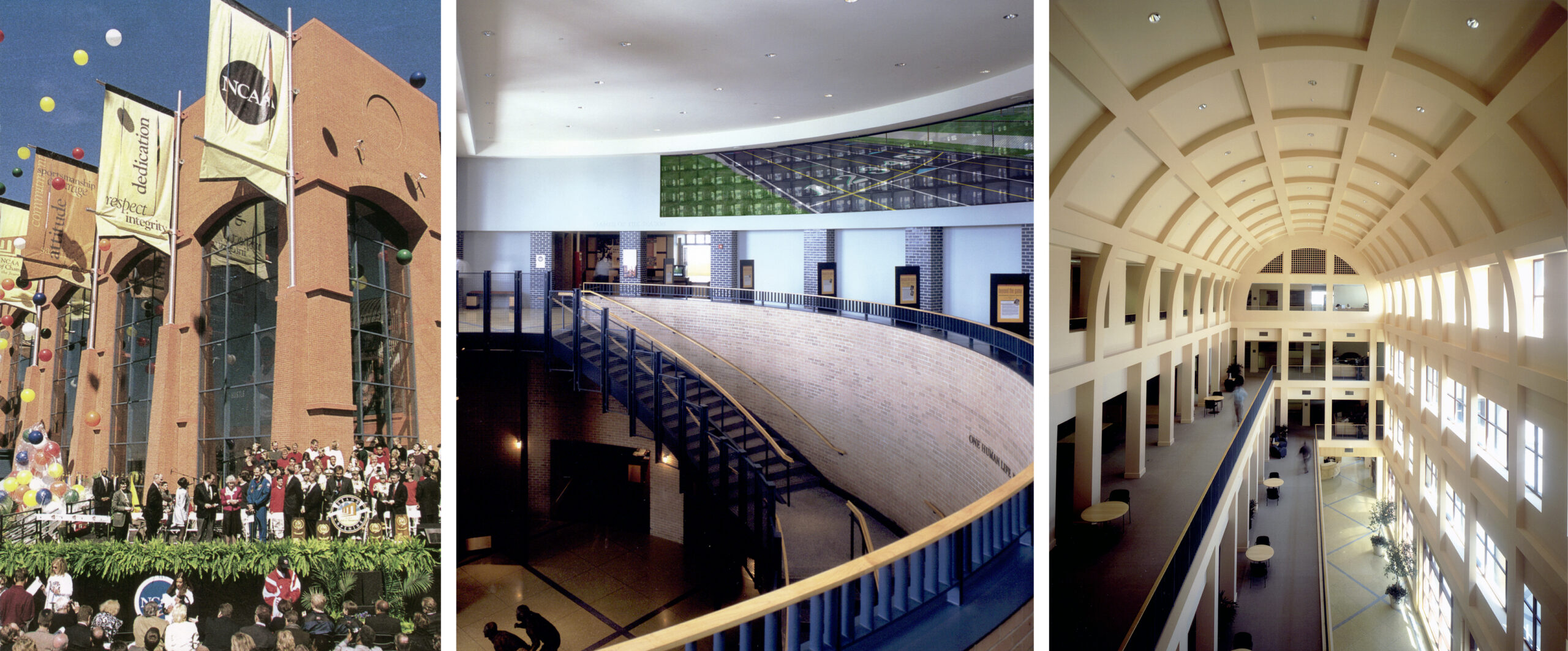
The Hall of Champions opened publicly in 2000 during the NCAA Men’s Final Four— the first of many times Indianapolis would host that event.
RECOGNITION THAT WENT BEYOND THE DESIGN
The project earned significant recognition, including an AIA Indiana Citation Award, a Monumental Affair Merit Award, the Indiana/Kentucky Golden Trowel Award for outstanding achievement in masonry design, and an Indiana Concrete Masonry Association Commercial Design Award.
It also earned something the design awards do not capture. In March 2000, the NCAA presented Schmidt Associates with “The Flying Wedge”—not for the architecture, but for the relationship. For the team-first approach the firm brought to a complicated, multi-firm project on a tight urban site with the whole city paying attention. Schmidt Associates was honored to be recognized for it.
STILL BUILDING, STILL HERE
Indianapolis is guaranteed at least one major NCAA event every year through 2039 and will host the men’s Final Four in 2029, a commitment that traces directly to the moment the organization chose to call the city home. None of that happened without partners willing to invest in the vision before it was proven. Schmidt Associates has been one of those partners since before Indianapolis knew what it was becoming. The NCAA Headquarters was not a footnote in that story. It was a chapter.
Fifty years in, the work has not changed: designing for the Owner, the community, and the long view.
Hear the full story. This project was featured in our anniversary podcast series, where we walk through the decades that shaped Indianapolis and Schmidt Associates. Listen to the episode below.
Share this post on