




When Bus Travel Became Beautiful—How a Louisville Terminal Launched an Architectural Movement
-
Category
Anniversary, Perspectives -
Posted By
Schmidt Associates -
Posted On
Feb 27, 2026
The 1937 Louisville Greyhound station did not just change bus travel; it redefined what transportation architecture could be.
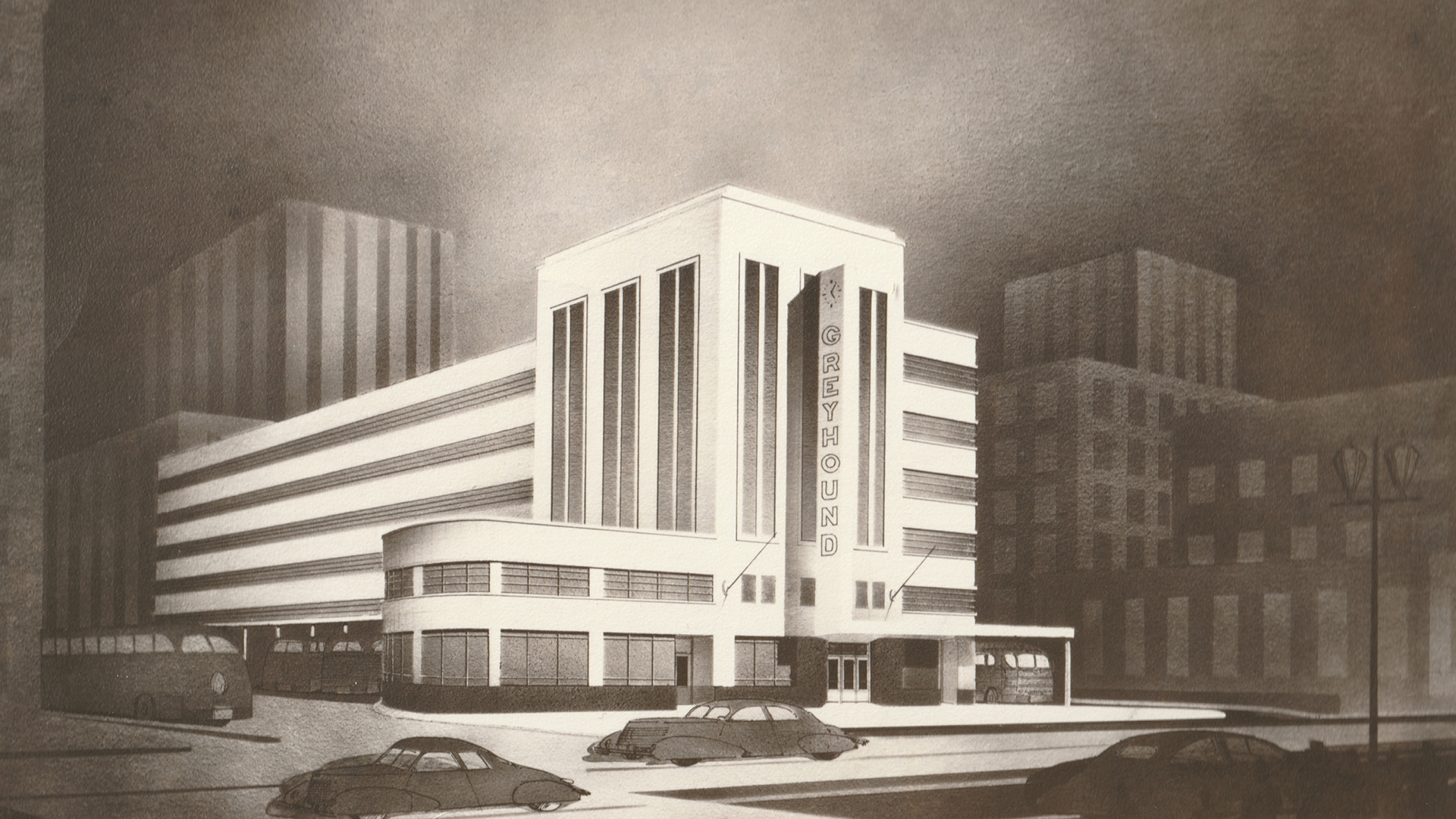
Before Louisville’s iconic Greyhound bus station opened at Fifth and Broadway in 1937, bus terminals were functional afterthoughts—utilitarian spaces designed to move people, not inspire them. Architect William S. Arrasmith imagined something different.
What if a bus station could be as sleek and modern as the buses themselves?
As we approach our 50th anniversary in 2026, we reflect on the projects that shaped who we are. Few carry more influence than the work of William S. Arrasmith. When his firm joined Schmidt Associates, we inherited more than a portfolio—we inherited a philosophy. His pioneering spirit continues to shape our work.
A terminal unlike any other
When the Louisville Greyhound terminal opened in 1937, it stopped people in their tracks. The exterior gleamed with “Greyhound Blue” porcelain enamel steel panels—a revolutionary application representing the largest use of porcelain enamel in the world at that time, costing $150,000.
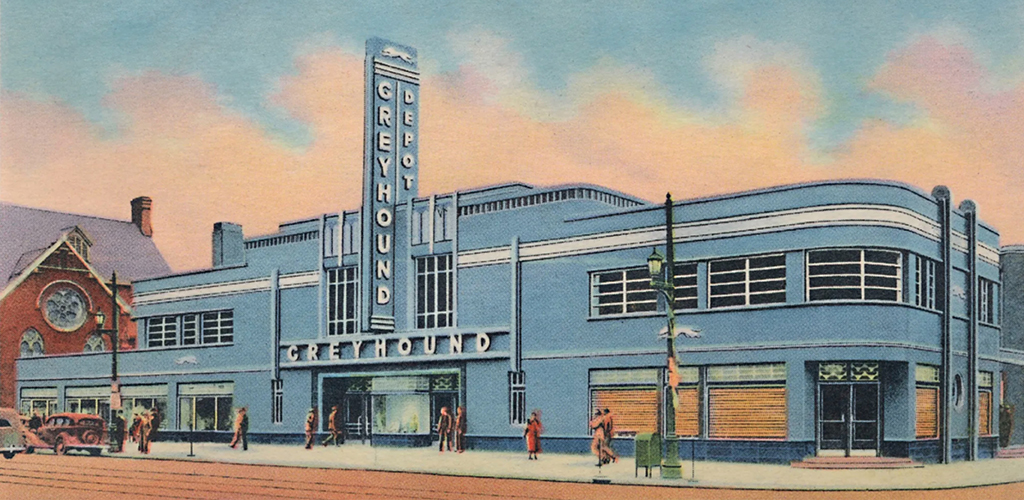
Photo Credit: Print Collector/Hulton Archive
The innovation, however, went far beyond material. Arrasmith embraced a holistic design approach. Every element worked in concert to express the Streamline Moderne style: horizontal bands, aerodynamic curves, and a sense of forward motion even at rest. The building featured the first large neon sign constructed as an integral part of its architecture. Inside, seating echoed the blue leather and chrome steel tube frames found on Greyhound’s Supercoach buses.
Arrasmith understood something fundamental: Design shapes experience. Imagine arriving in Louisville in 1937. The bus doors fold open. Neon glows against polished steel. For many travelers, this was not just a stop along the way — it was their first glimpse of a larger, faster, more hopeful world.
From one terminal to a movement
Recognizing Arrasmith’s vision, Greyhound commissioned him to design approximately 50 stations across the United States from 1937 through the late 1950s. Each expanded on the principles first realized in Louisville. His terminals rose in Washington, D.C., Cleveland, Cincinnati, Evansville, Montgomery, and Richmond, among others—each bearing his unmistakable signature: flowing horizontal lines, a disciplined balance of curved and rectilinear forms, and rigorous attention to both aesthetics and function.
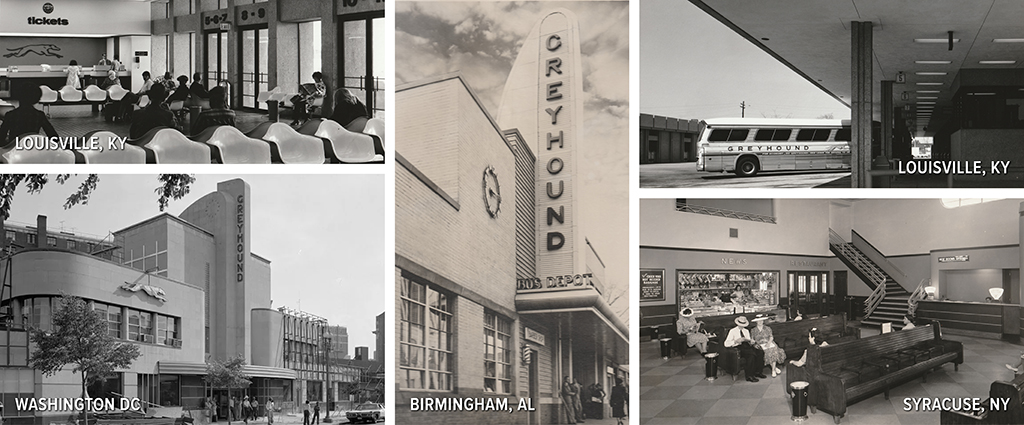
The Cleveland station, completed in 1948, stands as perhaps the most ambitious realization of that vision. Hailed at its opening as “the greatest bus terminal in the world,” it featured 21 bus docks and served an estimated 3 million passengers annually at its peak. Long before the phrase “community-centered design” entered the professional vocabulary, it demonstrated that infrastructure could be efficient, civic-minded, and architecturally bold.
A legacy preserved
Though the original Louisville terminal was demolished in 1970, its influence endures. Several Arrasmith-designed terminals survive in new forms, many recognized on the National Register of Historic Places.
In 2022, former principal and healthcare consultant J.R. Robertson donated the original drawings to the Filson Historical Society in Louisville. Preserving those plans was not simply about safeguarding paper. It was about protecting a philosophy — the belief that everyday infrastructure deserves dignity, intention, and care.
What we inherited
When Arrasmith’s firm became part of Schmidt Associates, we gained more than a lineage of projects. We inherited a philosophy.
Arrasmith believed the spaces people move through every day deserve the same care and intention as any landmark building. He believed thoughtful design could shape how people feel about a journey before it even begins. And he believed transportation infrastructure was not merely a civic necessity—it was a reflection of a community’s aspirations.
That conviction continues to inform our work.
A legacy that moves communities
Nowhere is that more evident than in the transportation centers we design for school communities across the Midwest. They may not appear in architecture magazines, but for the families and students who rely on them, they matter just as much as any landmark structure.
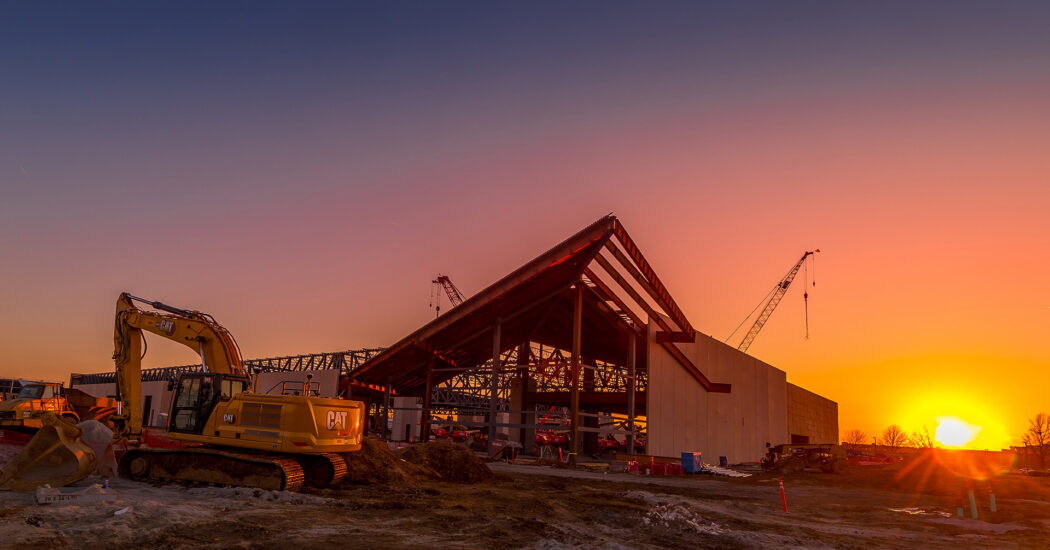
Consider the H. Donald Inskeep Transportation Center. Named for a long-serving school administrator, it embodies the same principle Arrasmith brought to every Greyhound station: facilities should function seamlessly, feel welcoming, and reflect the dignity of those they serve. It is not about bus bays alone. It is about the student who feels safe, the driver who works efficiently, and the parent who feels confident.
That same philosophy guides our work on the Westfield Washington Schools Transportation Center and the Lebanon Transportation Center. Each project demands careful attention to flow, safety, and human experience—not just square footage and vehicle counts.
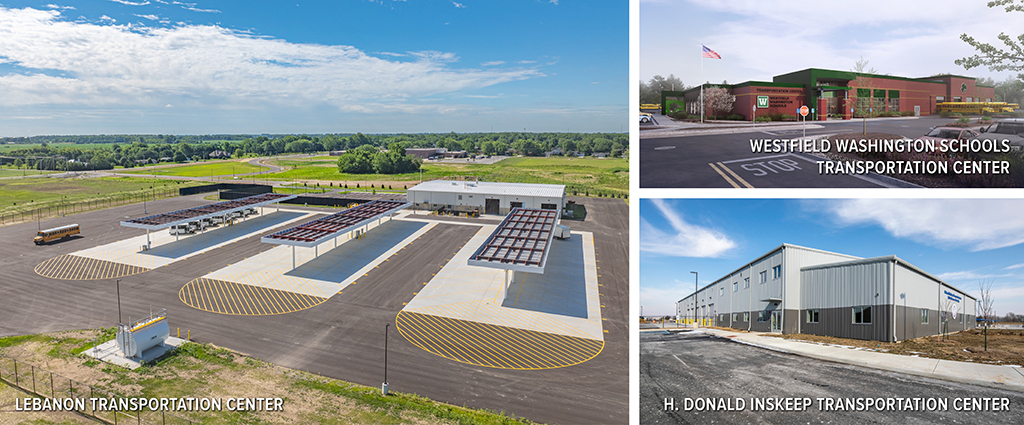
A standard that endures
Arrasmith changed the way a city experienced arrival and departure. His work demonstrated that infrastructure could set a tone—for travel, for progress, for possibility.
That influence is not confined to history. It lives in the expectations communities bring to every project today. They expect facilities that perform. They expect environments that reflect who they are. They expect buildings that are ready for what comes next.
As Schmidt Associates prepares to enter its sixth decade, we see that expectation as both responsibility and opportunity. The legacy we carry forward is not a style, a material, or an era. It is a standard.
And that standard continues to guide the work ahead.
Discover more stories where innovation meets legacy
- Explore our 50-year legacy
- Restoring a symbol: How the Soldiers and Sailors Monument endures for generations
- More than 30 years of partnership, progress, and purpose
- One historic building that helped spark Mass Ave’s comeback
Share this post on