





Right-Sizing Spaces: Designing Educational Facilities for Shifting Enrollment
-
Category
Studio-K12, Studio-Higher Ed, Innovation -
Posted By
Schmidt Associates -
Posted On
Mar 27, 2026
How flexible facilities planning helps K-12 schools and universities adapt to changing enrollment and evolving program needs.
Enrollment shifts affect both K-12 school districts and colleges and universities. Communities grow, plateau, and sometimes shrink. Student interests evolve. Academic programs expand or change. The institutions that navigate those shifts most successfully tend to have one thing in common: they planned for them.
One of the most effective ways schools and universities prepare for change is through right-sizing—designing facilities that align with real needs today while remaining adaptable for the future.

At Schmidt Associates, we work with K-12 districts and higher education institutions across Indiana and Kentucky to help plan facilities that support current enrollment while remaining flexible enough to adapt as demographics, programs and learning models evolve. The question is rarely just, “How many students do we have right now?” It is, “How do we build something that works for the next 20 to 30 years, even if those numbers change?”
The problem with fixed thinking
When a building is designed around a single enrollment scenario, it becomes a liability the moment that scenario shifts. A K-12 campus built for 800 students struggles operationally at 600. Utilities, staffing, and maintenance costs do not scale down as easily as headcount. A residence hall designed for a specific occupancy leaves institutions scrambling when demand exceeds capacity or leaves beds empty when it falls short.
The alternative is not simply building bigger or smaller. It is building smarter. Flexible design means asking different questions from the start: Which spaces could serve multiple uses over time? What structural decisions today preserve options in the future? How do we make this building work across a range of scenarios, not just one?
What right-sizing looks like in practice
Future-focused planning means designing buildings that can adapt as student needs evolve.

The following examples show how this kind of long-term thinking plays out in real projects:
K-12: Planning For the Long View
At MSD of Washington Township, Schmidt Associates developed a campus master plan that helped guide a $50 million referendum, the largest in Indiana’s history at the time. The plan balanced renovations, a new off-site middle school to support enrollment growth, and a relocated preschool to free up high school capacity. Rather than solving for one moment in time, it created a flexible roadmap for the next two to three decades.
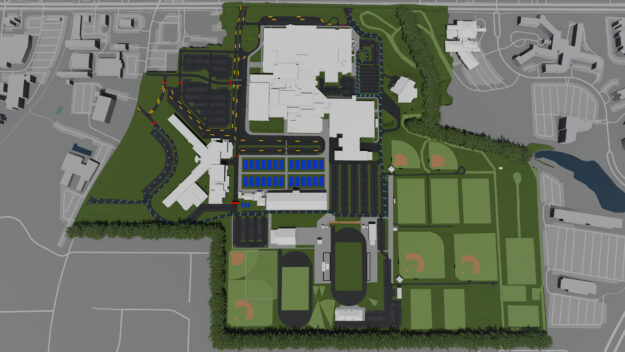
The result is a campus strategy that allows the district to respond to enrollment changes without constant facility disruption.
K-12: Spreading Investment Across a Campus
For Tipton Community Schools, right-sizing meant distributing a $5 million budget strategically across an entire K-12 campus so every student, regardless of grade level, saw meaningful improvement. Instead of concentrating investment in a single new building, the district modernized multiple areas, improved safety, and expanded shared spaces in a way that serves a range of future enrollment scenarios.
This approach allowed the district to strengthen the entire campus while preserving flexibility for future enrollment shifts.
Higher Education: Flexibility Built In
At the higher education level, our work on Ball State University residence halls shows how the same principle applies. Jack Beyerl (North) Residence Hall was designed for science, technology, and math students, with makerspaces, flexible lounges, and collaborative study areas that support the specific community living there today, but are also adaptable as that community evolves.
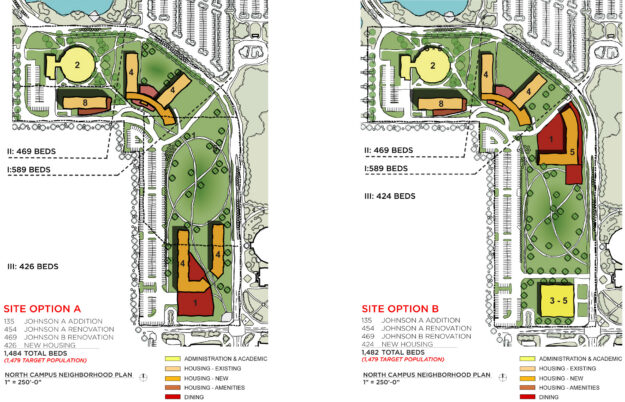

The design supports the needs of today’s living-learning community while ensuring the spaces can adapt as student programs evolve.
Wright Quad at Indiana University took a different approach. The project reclaimed underused rooms to create new lounges and converted a former lounge into a classroom, adding programming flexibility without expanding the building’s footprint.
By reimagining existing spaces, the University gained new programming flexibility without expanding the building footprint.
The design questions that matter most
These conversations often begin with a facility assessment or campus master planning process. By evaluating the condition, capacity, and utilization of existing buildings, institutions gain a clearer picture of how their spaces are performing today and where flexibility will be needed in the future.
In our experience, the most important conversations in any educational facility project start with scenarios. Understanding how enrollment and program needs may shift helps guide every design decision, from space planning to finishes.
Cindy McLoed, project manager at Schmidt Associates, notes that flexible K-12 spaces often come down to a handful of intentional design decisions: accessible sinks, ample power, extra room exhaust, mobile visual displays, and operable walls between adjacent rooms—elements that allow a space to evolve right alongside a changing curriculum.
Key questions institutions should ask include:
- What does your enrollment look like in 10 years?
- How confident are you in that projection?
- If enrollment is off by 15 percent in either direction, does the building still work?
- Are there spaces that can shift from one use to another without significant cost?
These questions are not pessimistic. They reflect the kind of foresight that turns a good capital investment into a lasting one. Whether working with a school district navigating growth or a university managing changing student preferences, our role is to help institutions make decisions that remain strong long after ribbon-cutting.
Planning for what comes next
Right-sizing is not about building less. It is about building wisely so facilities continue serving students, educators, and communities as needs evolve.
Institutions cannot predict the future of enrollment, but they can plan for it. At Schmidt Associates, we help schools and universities design facilities that remain flexible as needs evolve. Explore how right-sizing can support your campus’s future.
Share this post on